The MAU Family Promise
A promise only means something if you can check it. Here's ours, in full.
We've never wanted "we respect other cultures" to be a line on a website nobody checks. So we wrote down, in full, what that actually means when it comes to building a children's platform, and we're publishing it here in its entirety, not a summary, not a highlight reel. This is the real document that governs everything Maggie says, shows, and teaches.
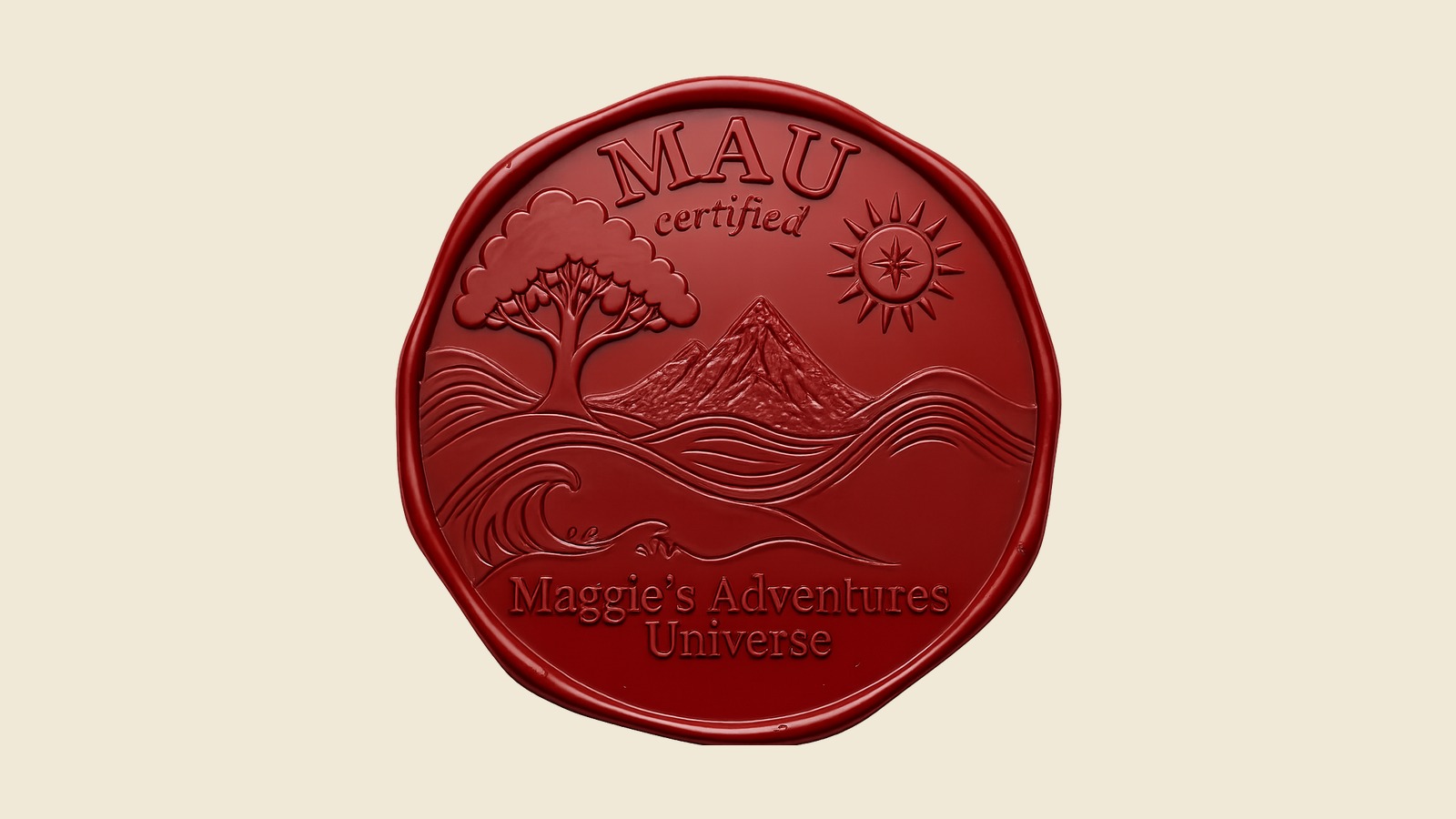
We call it the MAU Family Promise, and it's the standard behind the MAU Seal you'll see on parts of the platform. If something carries the Seal, it's been held up against everything below.
Five Foundational Principles
Understand a culture on its own terms. Nothing in Maggie's world is measured against what's "normal." Every custom, every belief, every way of living makes sense from inside the logic of the people who live it, and that's the only fair way to understand it. Treating what's unfamiliar as strange is a habit every culture can fall into about every other culture, in any direction, and we work against it everywhere, not from any single vantage point.
Prefer the insider's understanding over the outsider's description. Wherever possible, we describe a place, a festival, or a tradition the way the people who live it would recognise, not the way it looks to someone passing through.
Cultures are living and plural, never a single monolith. No culture is one thing, and no culture speaks with only one voice. We try to reflect that plurality rather than flatten it.
Living peoples are described in the living present. We never write about a culture only in the past tense, as though it exists purely in tradition and not today. The people we write about are living now, in the same year as the child reading about them.
Respect the living world as carefully as we respect living people. Wildlife and habitats are never a backdrop or a prop in Maggie's stories. We follow an observe-don't-intrude ethic: watch, don't feed; admire, don't touch; keep a respectful distance rather than chase for a better view. This one is personal, not just policy, respect for the natural world is something we care about deeply as a company, and it gets the same weight as everything above it.
What we won't do
Alongside the Principles, the Promise sets hard lines we don't cross, regardless of story, age tier, or destination:
No presenting a people as strange, exotic, or a curiosity. No ranking one way of life as better or more advanced than another. No freezing a living culture in an imagined, timeless past. No treating someone's religion as simply true or false, right or wrong, only ever as what it means to the people who hold it, alongside the same respect for what's empirically known, without either one having to lose for the other to be honoured. No encouraging a child to feed, touch, or disturb wildlife, and no treating a natural place as disposable scenery. Understanding why something happens in a culture is never permission for it to cause real harm. We can explain circumstances with empathy for the people involved, without ever presenting harmful practices to a child as something to copy. How this actually shows up for a child
This isn't a philosophy document sitting apart from the product. It governs what a child actually sees:
In Story, Maggie never encounters a place as a curiosity. She meets people whose lives make sense on their own terms, and where possible, local voices speak for themselves in her stories rather than only being described by her. In Explore, a destination's food, geography, and daily life are shown as lived now, not staged as spectacle. In Language, we teach how people actually speak, not a flattened phrasebook version of them. In Culture, religion and belief are presented as what they mean to the people who hold them. In Wildlife, the same respect extends to the animals and land a people share their home with, described on that community's own terms.
Some ground gets extra care no matter how briefly it comes up: religion and sacred belief, Indigenous knowledge and history, and any historically contested or painful chapter of a place's past. These are never treated as simple facts to state and move past.
What the Seal means
Where you see the MAU Seal, it isn't a stamp for the whole company, it names one specific thing, a piece of content, a place, a partnership, and says that thing has been checked against everything above. The Seal is binary: something either meets the standard or it doesn't yet, there's no watered-down tier. Not having the Seal yet doesn't mean something failed, it can simply mean it hasn't been reviewed yet.
It also isn't something earned once and kept forever. The Seal has to be earned, and then earned again, continually, over time. Meeting this standard on the day something is reviewed doesn't guarantee it still meets it a year later, cultures change, our own understanding deepens, mistakes get found. So nothing carries the Seal permanently by default. Anything can be re-reviewed, and the Seal can be withdrawn the moment something no longer holds up. We'd rather a piece of content lose its Seal and go fix itself than keep a badge it no longer deserves. That ongoing accountability, not the badge itself, is the actual point.
Where this comes from
We didn't write this from opinion alone. The Promise is grounded in real, citable work: Franz Boas's foundational thinking on cultural relativism, the emic/etic distinction developed by Kenneth Pike and Marvin Harris, Johannes Fabian's critique of writing living peoples only in a timeless past, Chimamanda Ngozi Adichie's argument about the danger of a single story, Linda Tuhiwai Smith's work on decolonising research with Indigenous peoples, UNESCO's Convention for the Safeguarding of Intangible Cultural Heritage, and the Leave No Trace principles that shape how we teach children to move through wild places.
Why we're publishing all of it
We could have written a shorter, safer version of this for the website and kept the rest internal. We didn't, because the whole point of a promise is that you can check it. If Maggie ever gets something wrong, and across enough stories and destinations, something eventually will slip through, this is the standard you can hold us to, in public, in writing, not after the fact.
That's what bringing the world closer together actually requires: not just good intentions, but a standard specific enough to be broken, and honest enough to publish.
🌍 Travel The World Lightly 🌿
Nicolas F. S. Zaslavoglou
Founder · Storyteller · Adventurer, Maggie's Adventures Universe
Free download
The Little Explorer's Kit
A free bundle for curious families: a printable world explorer journal, a wildlife spotting sheet, and a first-words language card set.
Stay updated
Occasional notes from Maggie's world. No spam, ever.