MAU's Approach to Global Citizenship Education
What does it actually mean to raise a global citizen? We looked at fifteen years of research to find out.
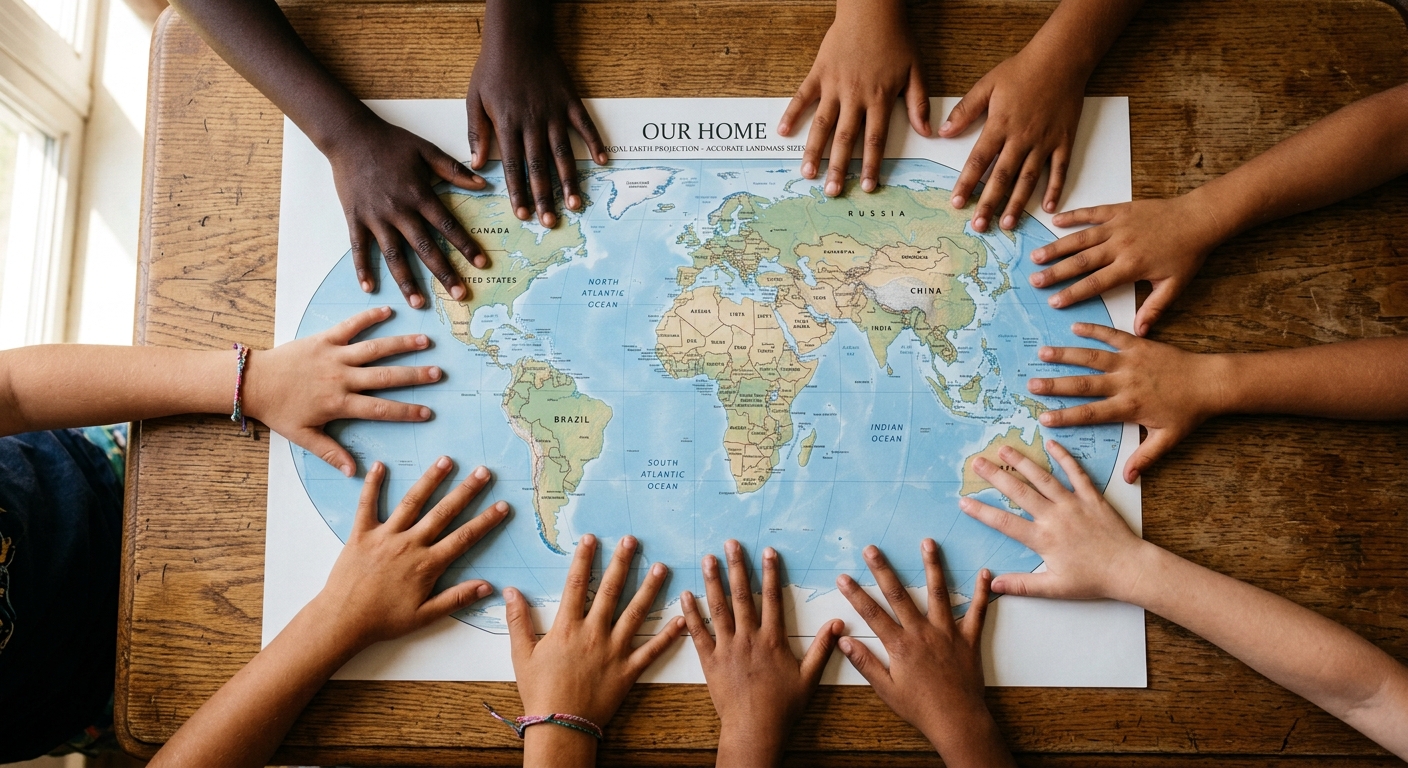
Fifteen years ago, UNESCO coined a term at its General Conference: global citizenship education. Four years after that, it was written into the Sustainable Development Goals, Target 4.7, as something every country in the world committed to promoting. Three years after that, the OECD built an actual international assessment around it, testing what fifteen-year-olds in over a hundred countries actually understand about engaging with people and issues beyond their own borders, a measurement it has now run for years.
That is not an empty field waiting for a definition. It is a mature one, with two major international institutions behind it and fifteen years of accumulated study, alongside traditions that many countries built on their own terms, some well before the term existed. Japan has cycled through several names for roughly the same idea since the 1970s, kokusai rikai kyōiku, tabunka kyōiku, ibunkakan kyōiku, taught through a flexible cross-curricular period rather than one fixed subject. South Africa folded citizenship, human rights, and cultural diversity into a compulsory subject called Life Orientation, built directly out of its own post-apartheid constitution. Colombia created Cátedra de la Paz in 2015, a mandatory peace and citizenship course born out of the end of its decades-long internal conflict, answering a need nobody else's framework could have written for them. The UK splits the same territory into separate subjects. The US revised its own definition in 2023 and immediately found scholars arguing about what got added and what got left out.
We want to be honest about where that leaves us: MAU has only just started studying this field seriously. We are not arriving with fifteen years of research behind us, and we are not claiming to be. What we can offer, from day one, is transparency about how we're approaching it, and a public standard we're willing to be held to while we learn.
Why
Global citizenship education already has serious, hard-won definitions behind it, from UNESCO, from the OECD, and from individual countries who built their own versions out of their own history. We are not trying to replace any of that, and we don't think a company our age has any business claiming to. What we noticed, studying this field from the outside as a children's platform, is that most of these frameworks were built for education systems and policy, not for a specific product deciding, line by line, what a child actually sees when they meet somewhere unfamiliar.
We already had to answer a narrower version of that question, for an entirely different reason. The MAU Family Promise is the document that decides what a child sees, hears, and is taught every time they encounter a new place inside our platform. It wasn't written as a contribution to global citizenship scholarship. It was written because we had no choice, someone had to decide, concretely, what counts as treating a culture fairly. Having done that, we think the answer is worth showing plainly, and holding up against the standard the wider field has already spent fifteen years building.
What
Our working approach to global citizenship education starts from one plain idea: meeting a person, a place, or a tradition on its own terms, closely enough that curiosity replaces assumption.
That isn't a new academic definition competing with UNESCO's or the OECD's. It's a restatement of the Family Promise (Version 2.2) in terms a parent or an educator can actually use, and every part of it traces back to a specific, named Principle in that document, not a paraphrase of one:
Meeting something on its own terms, not measured against what's familiar, is Principle 1: cultural relativism, understanding a practice from inside the logic of the people who live it. Understanding closely enough, not from a distance, is Principle 2: preferring the insider's understanding, the emic, over the outsider's description, the etic. Treating a people as they actually are today, not as a single flattened idea of them, is Principle 3 (cultures are living and plural, never frozen or singular) combined with Principle 4 (describing living peoples in the living present, never only in a timeless traditional tense). And the same standard extends past people to the natural world a culture shares its home with, respected with the same seriousness, not treated as scenery, Principle 5.
We're not willing to let our own application of this field diverge from the standard we already hold ourselves to. The Promise itself is explicit about this: it sits at the top of a three-tier document hierarchy (Part V), and its Governing Clause (Part VII) states plainly that where anything, a feature, a prompt, a partnership, or a piece of copy like this article, conflicts with the Promise, the Promise governs and the conflicting element is corrected. If the two ever pulled apart, that clause is what would fix it, not our own good intentions.
How
A working approach is only useful if it comes with a way to actually build the thing it describes. Ours rests on three parts, deliberately combined rather than left to stand alone:
Structured exploration. A child gets to explore a real destination through story, built on the same sourcing standard as everything else in the Promise, never a caricature, never frozen in the past, never ranked against home.
Guided, off-screen reflection. After the story, the screen goes away. What follows is a task built to be done with a parent or a teacher, not alone and not on another device, a discussion question, something to draw, build, or role-play, designed to turn what a child just encountered into something they actually talk through with someone else. The point isn't the activity. It's the conversation it starts.
Real-world encounter. Nothing above replaces an actual meeting with someone different, whether that's a trip somewhere unfamiliar or simply a genuine conversation closer to home. That's still where the habit gets tested and made real. Our job isn't to substitute for that moment. It's to make sure a child walks into it already curious instead of wary.
None of this works as a "watch and learn" experience, and that's deliberate. A child who only ever watches a place never has to sit with the effort of understanding it. The whole model is built to interrupt passive consumption at exactly the point where a real conversation is supposed to start instead.
Where we go from here
We're not planting a flag in unclaimed ground, because there isn't any. Fifteen years of institutional work, and considerably longer in the traditions individual countries built on their own, deserve more respect than a company treating the field as empty and waiting to be named. What we can offer, honestly, is a new and still-learning voice, one concrete methodology, built openly on a standard anyone can check, and willing to be corrected as we go.
This is the first article we're publishing on how we're approaching this work. It won't be the last, and we intend for the standard above to be held to the same account as everything else we publish, checkable, correctable, and revocable if we ever fail to live up to it ourselves.
Sources referenced: UNESCO. Global citizenship education: what you need to know. UNESCO (2017). The ABCs of global citizenship education. OECD (2018). Preparing our Youth for an Inclusive and Sustainable World: The OECD PISA Global Competence Framework. Okano, K. "Patterns of variation in 'internationalising education' in Japan." Educational Studies in Japan: International Yearbook. South Africa Department of Basic Education. National Curriculum Statement Grades R–12: Life Orientation. Morales, E. (2021). "Peace Education and Colombia's Efforts Against Violence: A Literature Review of Cátedra de la Paz." Revista Latinoamericana de Estudios Educativos.
🌍 Travel The World Lightly 🌿

Nicolas F. S. Zaslavoglou
Founder · Storyteller · Adventurer, Maggie's Adventures Universe
Free download
The Little Explorer's Kit
A free bundle for curious families: a printable world explorer journal, a wildlife spotting sheet, and a first-words language card set.
Stay updated
Occasional notes from Maggie's world. No spam, ever.