What If Taking Care of Yourself Was the Same as Taking Care of the Earth?
The Beautiful Paradox That Changes Everything About Conservation
What If Taking Care of Yourself Helped Take Care of the Earth?
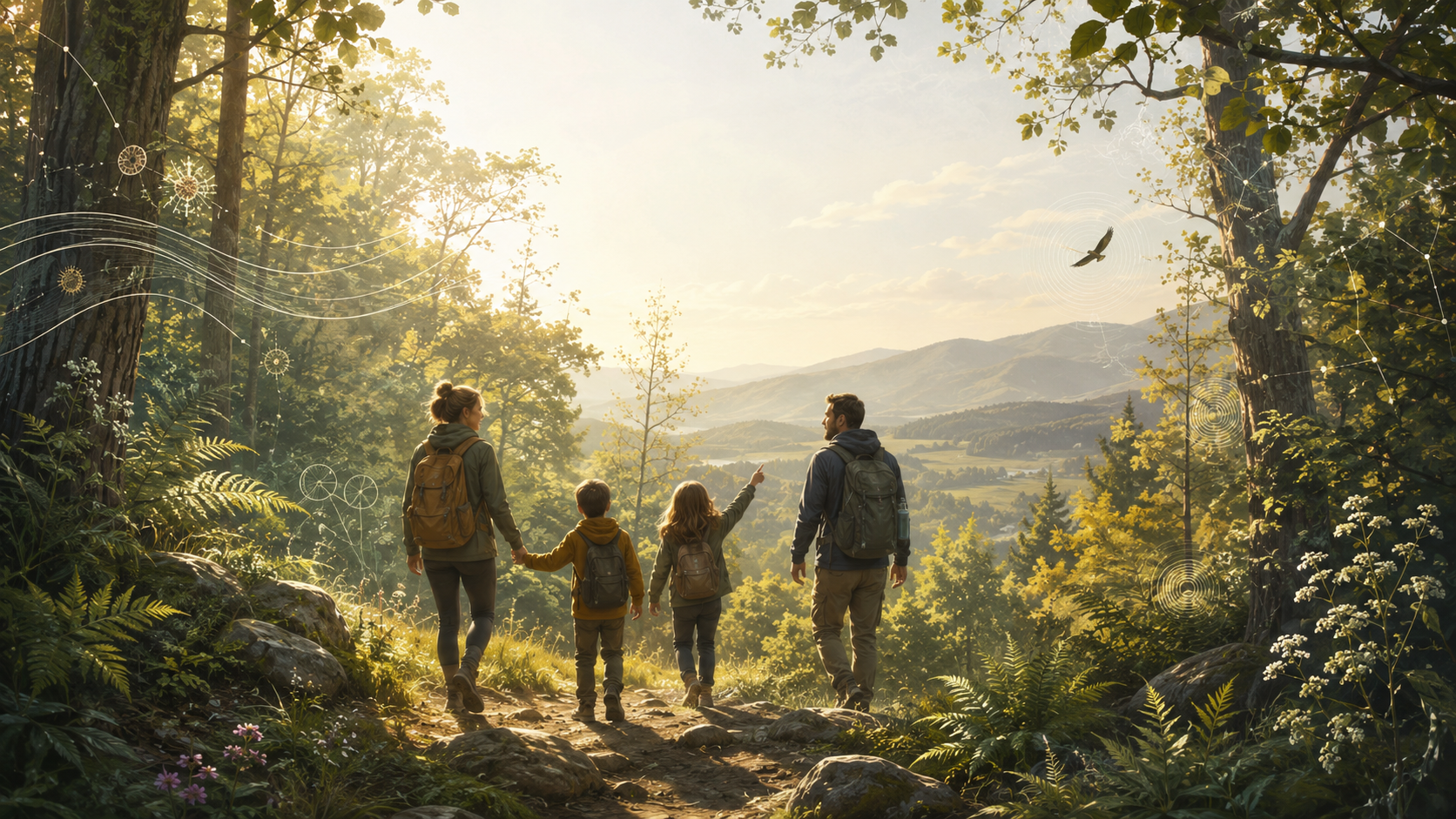
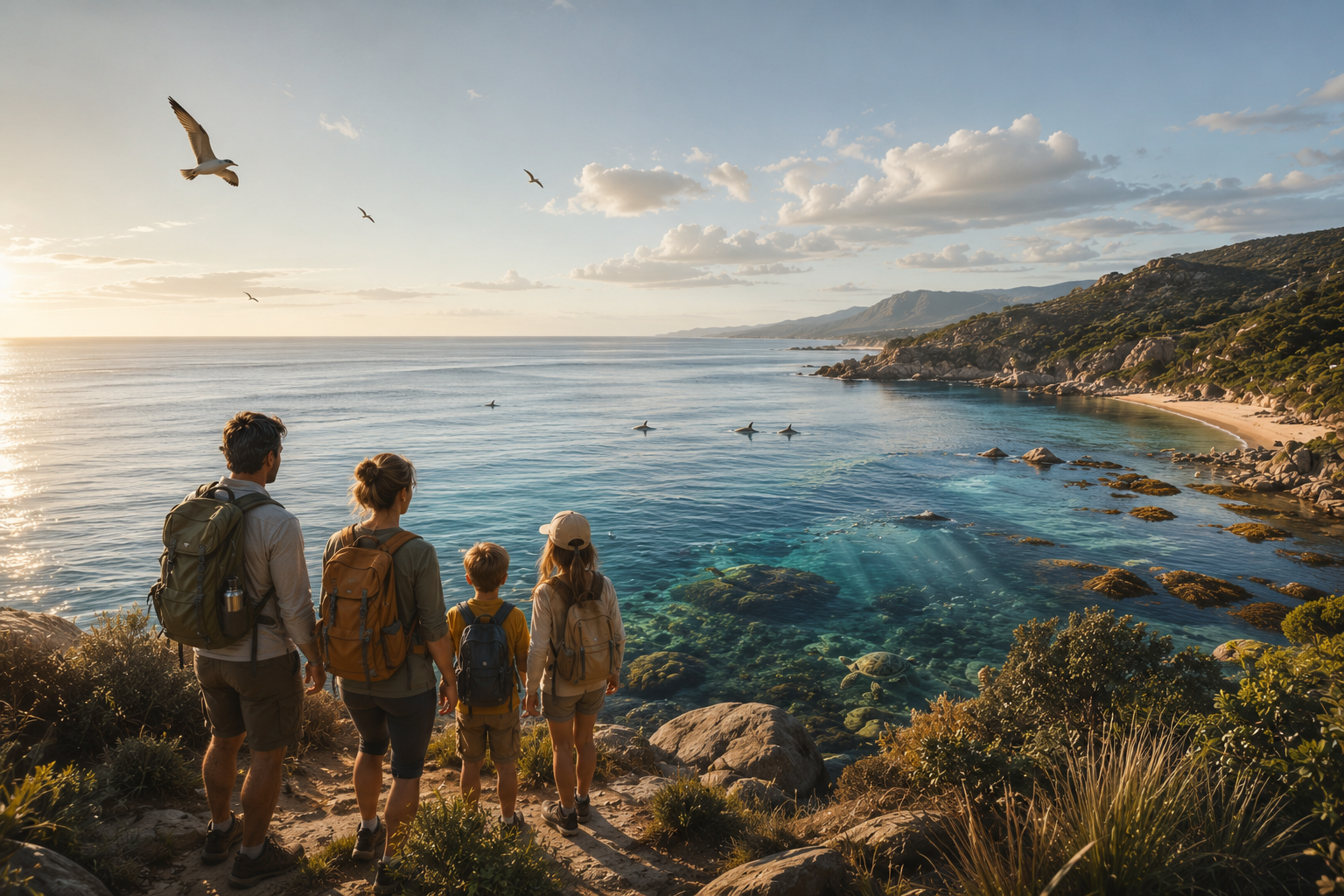
Here's an idea worth taking seriously, without overselling it: some of the things that are genuinely good for your family's health also happen to be things that depend on wild places continuing to exist. That overlap is real. What turns it from a nice thought into an actual conservation outcome, though, is a specific and practical choice: which operator or platform you book your adventure through. That's the part that does the work, not the adventure by itself.
What the research actually supports
Time spent outdoors has a reasonably solid evidence base behind a specific, modest claim: short, regular exposure to natural settings lowers cortisol, the body's main stress-hormone marker. A 2019 University of Michigan study found the steepest drop after 20 to 30 minutes outside, and a 2025 Vienna trial found something similar comparing a wooded area to an urban one. Both are real, published findings. Neither tells us much about multi-day wilderness trips specifically, since that's not what was studied.
For children, there's a growing and reasonably encouraging body of research (several scoping reviews from the last two years, plus at least one randomised trial of outdoor play in early childhood settings in Vancouver) linking unstructured outdoor play to better emotional regulation, creativity, and problem-solving. Worth flagging: most of this evidence is about outdoor play broadly, not wilderness adventure specifically, and a good deal of it is recent and still building toward consensus rather than settled.
Claims about improved cardiovascular health in adults are well supported in the general exercise science literature, but that's a finding about physical activity, not about wild places as such. Walking briskly through a city park and hiking a mountain trail both count as exercise; the cardiovascular research doesn't distinguish much between them. Claims about deeper sleep and stronger family bonds from adventure specifically aren't things we can point to a study for. They're part of why we personally love this work, but they're our conviction, not a citation.
The part that's genuinely interesting: connection predicts protection
Here's where the research gets more useful than a simple slogan. A large meta-analysis (147 correlational studies and 59 experimental studies) found that people with a stronger felt connection to nature engage in more pro-environmental behaviour, and are also, on average, healthier. Interestingly, the same analysis found that environmental education campaigns alone, without that felt connection, showed no measurable effect on behaviour.
That's worth sitting with. It suggests that facts and guilt-driven messaging aren't the most reliable route to conservation behaviour; a felt bond with a specific place might matter more. That's a genuinely science-backed idea. It's also a narrower claim than "your self-interest and the planet's interest align perfectly." Feeling connected to a place you love is not automatically the same thing as protecting it, and the research shows connection correlating with action, not guaranteeing it.
Where we need to be careful: guilt versus self-interest
We're tempted to say guilt-based conservation messaging simply doesn't work and self-interest is the sustainable alternative. That would be overreaching. The actual research is genuinely split.
One well-known study out of Princeton (Weber and colleagues, published in PLOS ONE) found that anticipating pride was a more effective motivator for pro-environmental choices than anticipating guilt, and that guilt appeals can trigger a defensive, resistant reaction in some people. That supports part of what we're drawn to here.
But a more recent study (2022, Journal of Environmental Psychology) found the opposite emphasis: guilt motivated pro-environmental behaviour fairly consistently across contexts, while pride's effect depended much more on the situation. And a separate qualitative study found that guilt-based messaging backfires specifically among people who are already less environmentally engaged, not universally.
Put plainly: the field hasn't converged on "guilt fails, joy succeeds." It's converged on "it depends who you're talking to, and what specifically you're asking them to feel or do." We'd rather say that honestly than build a clean narrative on a contested foundation.
The actual link: it's the operator, not the activity
Here's the honest version of the claim we were reaching for. Diving, in itself, does nothing for a coral reef. Hiking, in itself, does nothing for a forest. What actually matters is who you book with, and what that operator does with your money.
A dive trip booked through an operator that reinvests part of its revenue into reef restoration has a real, traceable environmental effect. A dive trip booked through an operator that doesn't, has none, even though the dive itself felt identical to the diver. The same is true of a hiking tour that funds reforestation versus one that doesn't. The health benefit to you is roughly the same either way. The conservation outcome depends entirely on the distribution channel and the operator you chose, not on the adventure itself.
That reframes the whole idea in a way we're comfortable standing behind: choosing where and through whom you book isn't a side detail, it's the actual mechanism by which your family's adventure can also become a conservation act. Not because adventure is inherently conservation, but because the right booking choice routes your spending toward the places you visited. That's a claim we can back up by showing you exactly where the money goes, rather than one that asks you to take the connection on faith.
Where that leaves us
We still believe something worth believing here, just stated more carefully. Looking after your family's wellbeing through time outdoors is genuinely good for you, on the evidence we have. Feeling a real connection to a place is one of the better-supported predictors of caring enough to protect it. And the choice of who you book your adventure through is where health and conservation actually meet: pick an operator that reinvests in the places you're visiting, and your trip does double duty. Pick one that doesn't, and it's just a lovely trip.
That's a smaller, more specific claim than "they are the same thing." It's also one we can show you evidence for, rather than one that asks you to take it on faith.
🌍 Travel The World Lightly 🌿

Nicolas F. S. Zaslavoglou
Founder · Storyteller · Adventurer, Maggie's Adventures Universe
Free download
The Little Explorer's Kit
A free bundle for curious families: a printable world explorer journal, a wildlife spotting sheet, and a first-words language card set.
Stay updated
Occasional notes from Maggie's world. No spam, ever.